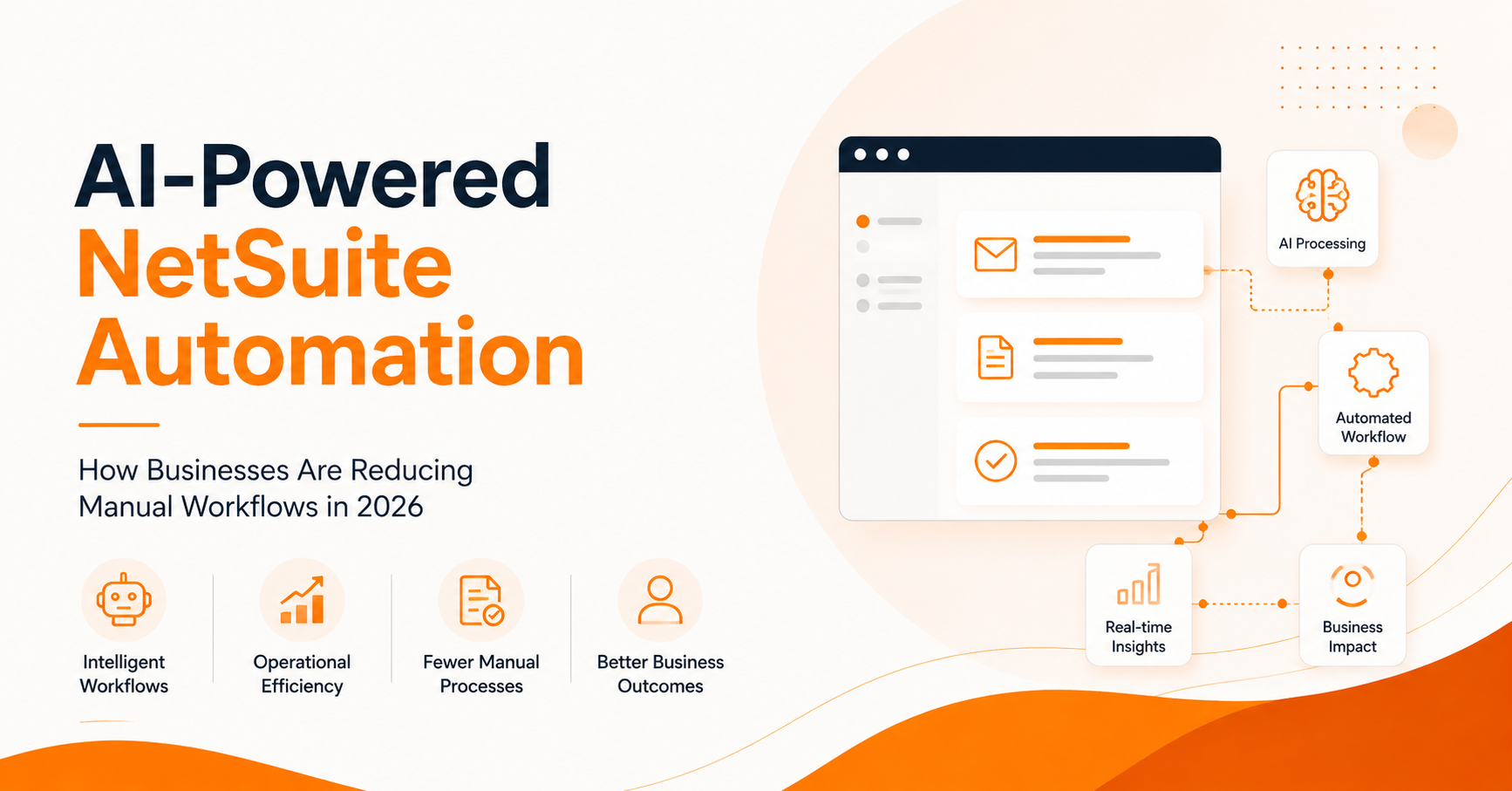
Artificial Intelligence is no longer a future concept within ERP systems — it is already reshaping how businesses operate inside NetSuite today.
Over the last 12 months, we’ve seen a major shift from simple scripted automation toward intelligent, AI-assisted workflows that reduce operational overhead, improve data accuracy, and accelerate business processes across finance, operations, fulfilment, and customer service.
At OptimizeMe, we work with businesses that are increasingly looking to automate repetitive processes without introducing unnecessary complexity or risk into their NetSuite environments.
The reality is that many businesses are still heavily reliant on:
- Manual data entry
- Spreadsheet-based processes
- Repetitive approval handling
- Manual remittance matching
- Customer service administration
- Human-driven reporting workflows
- Email monitoring and processing
These tasks consume valuable time and introduce avoidable human error.
With modern AI tooling and properly architected NetSuite integrations, many of these processes can now be automated safely and efficiently.
Where AI Is Making the Biggest Impact in NetSuite
1. Intelligent Invoice & Remittance Processing
One of the most common use cases we implement is AI-assisted remittance processing.
Traditionally, finance teams manually:
- Open remittance emails
- Identify customer payments
- Match invoices
- Handle formatting inconsistencies
- Create customer payments
AI can now extract structured payment data directly from emails and attachments, even when formats vary between customers.
Combined with NetSuite automation, this enables:
- Automatic payment matching
- Reduced finance administration
- Faster cash allocation
- Lower processing errors
- Improved finance team efficiency
This is particularly valuable for businesses processing high payment volumes daily.
2. AI-Assisted Customer Support Workflows
Customer support teams often spend significant time handling repetitive administrative tasks.
AI workflows can now assist with:
- Ticket classification
- Priority detection
- Suggested responses
- Customer sentiment analysis
- Automated escalation routing
- Internal knowledge retrieval
When integrated correctly with NetSuite and CRM systems, businesses can significantly reduce response times while improving consistency.
Importantly, this does not replace support teams — it enhances them.
3. Automated Approval Processes
Many approval processes still rely heavily on email chains and manual intervention.
AI-enhanced workflows can help automate:
- Purchase approval routing
- Expense verification
- Risk scoring
- Duplicate detection
- Supplier validation
- Exception handling
Rather than replacing approval controls, AI helps surface anomalies and accelerate standard transactions while maintaining governance.
4. Predictive Operational Insights
Modern AI solutions can analyse historical ERP data to identify operational trends that would otherwise be difficult to detect manually.
Examples include:
- Inventory forecasting
- Purchasing trends
- Customer payment behaviour
- Fulfilment bottlenecks
- Margin analysis
- Sales anomalies
This allows businesses to move from reactive decision-making toward proactive operational management.
Why AI Projects Fail in NetSuite
Despite the excitement around AI, many implementations fail because businesses focus on the AI itself rather than the underlying architecture.
Common problems include:
- Poor data quality
- Unstructured workflows
- Overcomplicated integrations
- Lack of governance controls
- No fallback handling
- Excessive customisation
- Unclear operational ownership
AI is only as effective as the systems and processes surrounding it.
This is why technical architecture remains critically important.
Building AI Automation the Right Way
At OptimizeMe, we approach AI automation with a “business-first” mindset.
The goal is not to add AI everywhere unnecessarily.
Instead, we focus on:
Identifying High-Value Repetitive Processes
The best automation opportunities are usually:
- High volume
- Repetitive
- Time consuming
- Rule-driven
- Prone to human error
Maintaining NetSuite Performance
AI workflows should never compromise ERP performance.
We ensure automation solutions remain:
- Scalable
- Governance-aware
- Fault tolerant
- Observable
- Easy to maintain
Keeping Humans in Control
The most successful AI implementations still include human oversight where required.
Examples include:
- Approval checkpoints
- Exception review queues
- Validation steps
- Confidence thresholds
This creates safer and more reliable operational automation.
The Rise of AI + NetSuite Integration Platforms
We’re also seeing rapid growth in businesses adopting integration and orchestration platforms alongside NetSuite.
Modern automation stacks commonly include:
- AI APIs
- Workflow orchestration platforms
- Document processing services
- Email automation
- OCR engines
- Approval platforms
- Cloud-based integration tooling
When implemented correctly, these systems can dramatically reduce operational overhead while remaining highly scalable.
Final Thoughts
AI is changing how businesses operate within NetSuite, but successful implementations require more than simply connecting an AI model to your ERP.
The businesses seeing the best results are focusing on:
- Strong process design
- Scalable architecture
- Governance-aware automation
- Operational visibility
- Controlled rollout strategies
At Optimize Me, we help businesses design and implement enterprise-grade NetSuite automation solutions that combine AI capabilities with scalable technical architecture.
Whether you are looking to:
- Automate finance workflows
- Reduce manual processing
- Improve operational efficiency
- Build AI-assisted integrations
- Optimise existing NetSuite customisations
- Implement scalable automation pipelines
our team can help.
Need Help Automating NetSuite Processes?
Optimize Me specialises in advanced NetSuite technical consulting, automation architecture, and scalable ERP optimisation across the UK and EMEA.
Our Services Include
- SuiteScript development
- AI-assisted automation
- NetSuite integrations
- Workflow optimisation
- Finance process automation
- SDF and CI/CD implementation
- NetSuite health checks
- Technical architecture reviews